
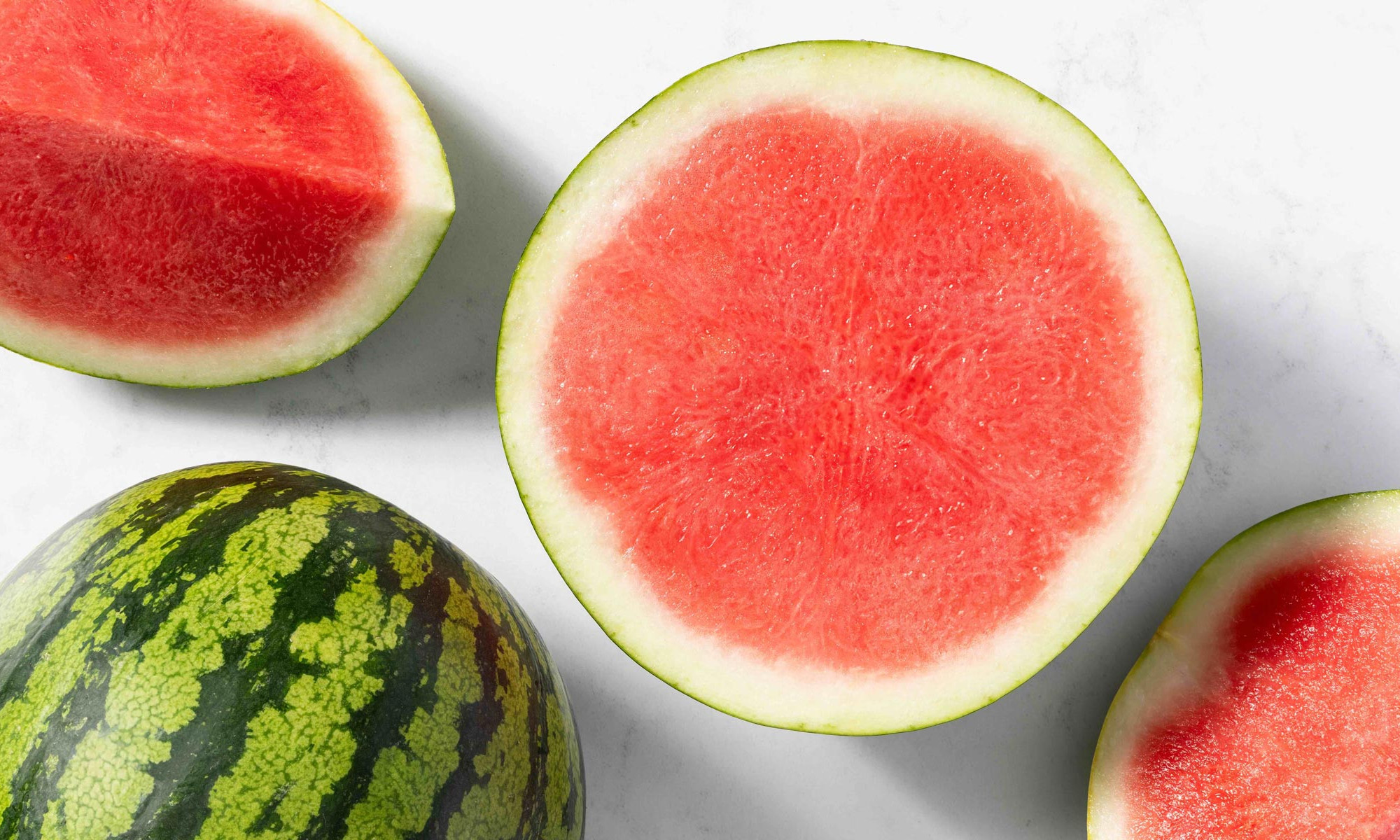
Seedless watermelon or seeded watermelon? For many, there’s a clear favorite, which is why those without seeds make up about 92% of all watermelon sales in the United States. Seedless watermelon has made our lives easier, adding to the convenience of taking watermelon on the go for a quick bite or post-workout snack. It also adds to the versatility we now have to play with watermelon in a huge variety of recipes, breakfast through dinner and dessert.
What Are Seedless Watermelons?
Despite its name, seedless watermelons can have few or no seeds. When we say seeds, we mean mature seeds (the black ones). Often, the white seed coats, where a seed did not fully mature, are assumed to be seeds. But this isn’t the case! They are perfectly safe to swallow while eating, and don’t worry — no watermelons will grow in your stomach despite the old wives’ tale.
How Are Seedless Watermelons Grown?
Chromosomes are the building blocks that give characteristics, or traits, to living things, including plants and watermelons. Watermelon growers discovered crossing a diploid plant (bearing the standard two sets of chromosomes) with a tetraploid plant (having four sets of chromosomes) results in a fruit that produces a triploid seed (yes, it has three sets of chromosomes.) This triploid seed is the seed that produces seedless watermelons.
In other words, a seedless watermelon is a sterile hybrid, which is created by crossing male pollen for a watermelon, containing 22 chromosomes per cell, with a female watermelon flower, with 44 chromosomes per cell. Each contributes half of its chromosomes to get the resulting triploid seed.
When this seeded fruit matures, the small, white seed coats inside contain 33 chromosomes, rendering it sterile and incapable of producing seeds. This is an example of simple cross-breeding, not genetic modification. Cross-breeding involves two parents and their offspring.
Importantly and interestingly, seedless watermelons still need to be pollinated by their seeded parent, so growers will plant seeded and seedless in their field. However, the seeded commercial harvest and retail sales only add up to about 8% of all watermelon sales, since seedless watermelon is so hugely popular in the United States!
Where Did Seedless Watermelons First Originate?
Seedless watermelons were invented more than 50 years ago in Japan, when Professor H. Kihara published an article on “Triploid Watermelons” in the Proceedings of the American Society for Horticultural Science. More interesting is how this work was brought to the public. O.J. Eigsti, one of the leading researchers in the United States at the time, was credited with helping to develop the seedless watermelon in the states and collaborated with Kihara in Japan. Eigsti was one of the founders of the “American Seedless Watermelon Corporation” that developed “Tri-X 313” and several other seedless varieties. Starting in 1951, it took more than 20 years from its inception to bring the fruit to the commercial industry we know today.
Are the Health Benefits the Same as a Seeded Watermelon?
According to the USDA FoodData Central, the nutritional health benefits for seeded watermelons are not differentiated from those that are seedless. The singular listing of “watermelon, raw” is what we use to populate the Food & Drug Administration (FDA) nutrition label, similar to the FDA nutrition labels we see on our packaged, fresh and frozen foods.
One serving of watermelon, or about two cups diced, has 80 calories, no fat, vitamin A (8%), B6 (8%) and C (25%), potassium (6%), magnesium (6%), thiamin (8%) and phosphorus (2%). It’s also made up of 92% water, making it a delicious way to rehydrate. For more information, view the whole FDA label here or discover more about watermelon’s wonderful nutrient lineup.
Can I Still Buy Seeded and Seedless Watermelons?
While many watermelon-lovers prefer the texture and convenience of biting into a seedless fruit, there are tons who still opt for the traditional seeded watermelon. Luckily for everyone, both are widely available across the U.S.! Watermelon growers plant seeded and seedless varieties, and all are harvested from the field. That means there’s plenty in the market to buy and enjoy!
Waste not, want not: If seeded watermelons aren’t sold as-is, they often are used for processing into juice or concentrate.
Whether you prefer seeded or seedless, we can all agree watermelon is a delicious way to stay hydrated and happy. Get the answers to all your juiciest watermelon questions with more frequently asked questions here.

Comments
What country invented seedless watermelons
Hi Steve,
We contacted some of our seed friends to get you the best answer. Here’s what we learned about what country invented seedless watermelons.
Professor H. Kihara from Japan published an article in 1951 on “Triploid Watermelons” in the Proceedings of the American Society for Horticultural Science volume 58, pages 217-230.
More interesting is how and finally this work got published. O.J. Eigsti, who was one of the leading researchers in the United States, was credited with helping to develop the seedless watermelon in the United States and collaborated with Kihara in Japan. Eigsti was one of the founders of “American Seedless Watermelon Corporation” that developed “Tri-X 313” and several other seedless varieties.
Took over 20 years to start the development of the commercial industry we know today from when this first started in 1951.
Dr. O.J. Eigsti of Indiana.
Yes,because watermelon 🍉 it is a good summertime
I have grown watermelons and they always have seeds but they are perfect but also there are problems like bugs, too much water, and getting rotten and mushy enough that I have to throw them in the compost, so can you give me details to handle the problems.
For all growing concerns find the Extension Service Agency for your state online at http://www.extension.org. These folks will be able to give you growing advice specific to your region!
If the pollen has 22 chromosomes and the egg has 44 chromosomes, then the seed should have 66 chromosomes. The wording her is confusing. If you mean the chromosome number is before meiosis, then the wording should not say the pollen has 22 chromosomes because pollen is the product of meiosis. Could you clarify please?
Hello Kristen,
We reached out to a plant scientist and researcher friend to answer your question. Here is her reply. We hope this helps answer your question.
The pollen is from a diploid plant (2N or 2 sets of chromosomes). The flower is from a tetraploid so it is 4N (4 sets of chromosomes). Each contributes 1/2 of its chromosomes to the resulting fruit: 1N and 2N or 11 from the pollen (which undergoes meiosis to form the pollen grains) and 22 from the female (the egg has also undergone meoisis), creating a triploid seed with 33 chromosomes. The triploid plant will grow and bloom, but the pollen produced on male blooms will not form a viable fruit with the female blooms, so diploids have to be planted with the triploids to provide pollen.
In response to the fact that “diploids have to be planted with triploids”, so why don’t the tetraploids have to be planted with the diploids as well?
Regards,
Alex
Each parent provides 1/2 their chromosomes…so papa has 22…providing 11 and mama has 44 providing 22 … totaling 33 in the seedless offspring.
Are the health benefits the same as with a seeded watermelon?
Hello Gina,
According to the USDA FoodData Central (previously known as the USDA Nutrient Database), the nutritional health benefits for seeded are not differentiated from seedless watermelon. The singular listing of “watermelon, raw” is what we use to populate the FDA nutrition label, similar to the FDA nutrition lables we see on our packaged, fresh and frozen foods. Here is the link https://fdc.nal.usda.gov/fdc-app.html#/?query=watermelon,%20raw.
I have seen “seedless watermelon “ seeds at the store. Would I have to plant both the seeded and seedless in my home garden to get the seedless variety?
Thank you for the question, Jan. And yes, a seedless watermelon flower needs to be pollinated by a seeded flower, it’s this crossbreeding that creates the hybrid, sterile seedless watermelon. There are also pollinator melons that some growers use commercially.
I prefer watermelon with seeds so my chance of having some are slim to now in this day and age?
What do farmers do with the regular watermelon they grow since it seems less popular and since seedless make up the bulk of watermelon in stores? Is it destroyed or is there a market to sell seeded watermelon and/or their pulp?
All watermelons are harvested from the field, and yes there is still a market for the seeded watermelon. While 10% of the market is made up of seeded watermelon as-is, some are used for processing into juice or concentrate.
Why are there few black seeded watermelon in stores. The black seeded are sweeter than the seedless ones.. Please bring back more supply of the black seed watermelon.
Referring to the April 16, 2020 message, you stated,” Each contributes 1/2 of its chromosomes to the resulting fruit: 1N and 2N or 11 from the pollen (which undergoes meiosis to form the pollen grains) and 22 from the female (the egg has also undergone meoisis), creating a triploid seed with 33 chromosomes. If the “egg” from a normal flower also undergoes meiosis, it would also have 11 chromosomes just like the pollen, and the hybred would be a normal diploid plant 11 + 11 = 22. What is unclear here is that the egg must comes from a flower on a plant that is quadraploid (wherein each cell has 44 chromosomes).
As I understand it, the egg comes from a normal (diploid) female plant that has been treated with a plant hormone that interferes with separation of the chromosomes during meiosos, and the egg of such a plant ends up with 22 chromosomes.
Thank you for the comment, Gerald. We conferred with our plant research specialists to further provide additional resource information. Seedless watermelon is a hybrid of two inbreds, where the male parent is a diploid, and the female parent is a tetraploid. The tetraploid is produced by doubling the chromosome number of the original diploid. Going from diploid (2 sets of chromosomes, or 2 x 11 = 22) to tetraploid (4 sets) can happen spontaneously. The polyploid frequency can be increased using colchicine (a natural compound from autumn crocus) or other chemicals.
See: http://cucurbitbreeding.com/watermelon-breeding/seedless-watermelon-breeding/
Are watermelons good for cats and dogs? I think they deserve something else to eat but.. I’m not really that good with figuring out what they eat and what they don’t eat
Yes! Watermelon is a safe food for all animals, including cats and dogs. We suggest giving them just the fruit part, not necessarily the rind. If you search online for ‘watermelon pet treats’ you’ll find an array of DIY recipes for them!
Why do Watermelons egsist???
I may be in the minority, but I find the flavor and texture of seeded watermelon to be far superior to seedless. Seedless watermelon seem tougher or more dense. I find the underdeveloped seeds more annoying than mature seeds that I can simply spit out. Give me a good vine ripened non cross bred watermelon.
except- That could be just cuz ur taste buds.
I totally agree with you!
I completely agree; Seeded are sweeter, juicier, free of the plastic-like texture and taste. Interesting how they carry a higher price.
I agree with you. seedless watermelon had something missing in texture and flavor. Seeded watermelon is now hard to find, even in Mexico and Costa Rica. In Canada you have to pay more for a seeded watermelon then seedless. I am sad that watermelon is going the way of the aweful tomatoes that never really ripen theses days .
You are absolutely right, I am 77 years old and I grew up eating watermelon all my life during watermelon season with black seeds, large sweet and juicy tasting good.. seedless watermelon are terrible. I don’t even buy them anymore because last summer I had to throw away six watermelons that had no taste. I cannot find black seeded watermelons anymore.
Jason, I agree with you 100%
Thank you for all the information I miss my watermelon I’m 72 years old love swallowing the s e e d s spitting them out smile my baby brother would tease me you better stop swallowing them you going to grow them in your stomach of course they didn’t smile
Is there a way to tell if a watermelon is seedless without cutting it open? I frequently buy seedless watermelon at the store only to get it home and cut it open to find out it is indeed seeded. Is there some way to tell by looking at it that it is indeed seedless without cutting it open?
The small white “seeds” in a seedless watermelon are actually just empty seed coats. They will never produce seeds, although watermelons may contain a couple of fully developed, hard, dark brown seeds. There is no way to tell if a watermelon won’t have the occasional “seed” before cutting it open.
How are seedless watermelons created? I need a little bit more detail on how the are created.
A diploid watermelon is planted. As it is growing, the “growing tip” is treated with colchicine. The seeds in the subsequent melons that are produced have four sets of chromosomes.
Can a home gardener grow seedless melons?
According to GardeningKnowHow.com:
Seedless watermelon growing is much the same as growing seeded varieties with a few differences. First of all, seedless watermelon seeds have a much more difficult time germinating than their counterparts. Direct sowing of seedless melons must occur when the soil is at a minimum of 70 degrees F. (21 C.). Ideally, the seedless watermelon seeds should be planted in a greenhouse or the like with temps between 75-80 degrees F. (23-26 C.). Direct seeding in commercial enterprises is very difficult. Overseeding and then thinning is a costly solution, as seeds run from 20-30 cents per seed. This accounts for why seedless watermelon is more expensive than regular watermelons. Secondly, a pollinizer (a diploid) must be planted in the field with the seedless or triploid melons. A row of pollinizers should be alternated with every two rows of the seedless variety. In commercial fields, between 66-75 percent of the plants are triploid; the rest are the pollinating (diploid) plants. In order to grow your own seedless watermelons, either begin with purchased transplants or start the seeds in a warm (75-80 degrees F. or 23-26 degrees C.) environment in a sterile soil mix. When the runners are 6-8 inches (15-20.5 cm.) long, the plant can be transferred to the garden if soil temps are at least 70 degrees F. or 21 degrees C. Remember, you need to grow both seedless and seeded watermelons. Dig holes in the ground for the transplants. Place one-seeded watermelon in the first row and transplant seedless watermelons into the next two holes. Continue to stagger your plantings, with one-seeded variety to every two seedless. Water the transplants in and wait, about 85-100 days, for the fruit to mature.
Read more at Gardening Know How: Information About Seedless Watermelon Seeds – Where Do Seedless Watermelons Come From https://www.gardeningknowhow.com/edible/fruits/watermelon/seedless-watermelon-plants.htm
are seedless watermelons have different health benefits than the normal watermelons with black seeds?
Seedless and seeded watermelon share the exact same nutrient information. At the USDA FoodData Central, you can look up watermelon’s nutrient properties which are listed only under “watermelon, raw” with no distinction between seedless or seeded flesh variety.
If I have 20 seeds to plant seedless watermelons and 10 seeds for the pollinator ace, how do I harvest seeds for future crops of seedless watermelons?
What would the number be if you had 30 seeds to plant seedless watermelons and 16 seeds for the pollinator ace. Would you recommend harvesting them in the winter??
Hello I was wondering if seedless Watermelon contain H302 in them as seeded ones do?
Hello Tony,
We reached out to an expert watermelon plant scientist for an assist on your question, however we are stumped. H3O2 seems to be a hydrate or some sort of alkalized water and is not something we are familiar with, although we know there is interest in higher pH water, vegetables, etc. Sorry, but we are unsure of how to even analyze this for watermelon.
Hello, is there a way to know whether the seeds we have are Triploid or tetraploid watermelon before growing them?
Hi,
There are no triploid seeds, only diploid and tetraploid.
In wheat they germinate the seed and collect fresh root tips that are placed in cold water or a colchicine solution solution to slow/disrupt the mitotic cycle. A squashing technique (art form in my opinion) on a microscope slide provides a means to do a chromosome count. Biological stains can also be used to identify chromosomes with banding patterns.
I feel like seedless watermelon is being forced on us. If it were a natural mutation that would be one thing, but it is a man made chemically enhanced mutation. Seedless fruits are a mutation., which means it would not naturally occur often enough to take up 92% of the market. I’d rather have the naturally occurring fruit, with the seeds. I have to go out of my way to find it. It’s never in the store. I wonder why seeded grapes and watermelon aren’t available anymore?
Watermelon is so good I love the way it slushes around my mouth and when it squirts watermelon juice it tickles me inside and it makes me feel so good after I take one bite of the watermelon. 🙂
Sincerly Kellan Micheal Carter
why so descriptive???
Seedless watermelon is a popular topic of conversation and there is much to learn!
Do you know if the colchicine used is directly derived from plants? Or was it synthetically recreated for large scale agriculture? It doesn’t bother me either way, just curious.
We reached out to a plant researcher friend to help find the answer to this. The colchicine can come from both natural and also synthetic forms. It is available from the crocus bulb and actually this alkaloid has also been used to treat gout. The herbicide oryzalin is a sulfonamide which appears to only be available as a non natural compound, and can induce microtubule disruption in meiosis and most likely used to generate triploid fruit as well.
Here is a link to a USA Today article that goes further quoting a watermelon seed breeder.
Is either parthenocarpy or triploid of watermelon are same? Because both are producing a seedless fruit then why we go for triploid?
Hello Narmatha,
We reached out to our plant researcher for help in answering this question. Here is her reply:
Triploid and parthenocarpic are different. Parthenocarpy is when a growth regulator is applied to a fruit and the fruit develops without fertilization. Sometimes this can happen spontaneously with the right temperatures and rainfall, that stimulate production of the hormone by the fruit. Triploid comes from cross pollination of a 4N and a 2N plant. The 4N has 4 copies of a chromosome and 2N has 2 copies. This cross creates a 3N plant (triploid). Because the number of chromosomes is not even, the embryos do not develop and create a ‘seedless’ fruit.
how do you get seedless watermelon
A seedless watermelon is a sterile hybrid which is created by crossing male pollen for a watermelon, containing 22 chromosomes per cell, with a female watermelon flower with 44 chromosomes per cell. When this seeded fruit matures, the seed inside contains 33 chromosomes, rendering it sterile and incapable of producing seeds. This is similar to the mule, produced by crossing a horse with a donkey.
The small white “seeds” in a seedless watermelon are actually just empty seed coats. They will never produce seeds, although seedless watermelons may contain a couple fully developed, hard, dark brown seeds.
I still think the seeded watermelons are sweeter.
Usually the seedless are sugarless aswell
If you would have to grow 3 watermelon plants (tetraploid and diploid) to get one triploid, sterile watermelon, and the seedless watermelon take up over 90% of the market, what happens to the other 2 watermelon.
I cannot believe there is just this random archive of cool factoids about watermelon. This is insane, I’ve learned so much. I’m curious- if seeded watermelons are necessary to grow alongside seedless watermelons, but only make up 8% of sales- does it work out that fewer seeded watermelons are grown and sold, or are seeded watermelons some sort of waste?
I’m just curious if there’s some sort of specific post growth use for seeded watermelon, or if it’s sold at a discount, or if it’s used for some other thing so as not to waste a perfectly good surplus. Can I learn a little more about that?
Seeded watermelons grow alongside seedless crops and are sold at retail. There is still quite a strong demand for consumers who want to buy the traditional, oblong seeded watermelon.
Hi, I always check weblog posts here in the early hours of the morning, as I love to gain more knowledge. I have been reading many of your stories, and I must say that they are pretty nice. I will definitely bookmark your site.
This post was truly remarkable, especially because I was looking for thoughts on this issue last Thursday.
Thank you, I appreciate it!
Pingback: La ciencia detrás del cultivo de sandías sin semillas - HISTORIA
Pingback: Can Birds Eat Watermelon? Is It Safe? – Bird Observe
I want to grow about a 1/4 acre of seedless watermelon, where can I buy the seeds to get started?
Oh, those sunny hot wonderful watermelon days! We always wished aloud that it didn’t have seeds. At least outdoors you could to spit them out on the grass. Not the concrete though, or Mom would make us sweep them away.
Other than convenience what are the benefits of seedless watermelon?
Working with watermelon in recipes, you have less waste with seedless watermelon since the fruit is used completed and as-is, without cutting around or losing flesh from the pocketing of seeds. Also the shelf life can be longer without those same seeds and seed pockets it leaves.